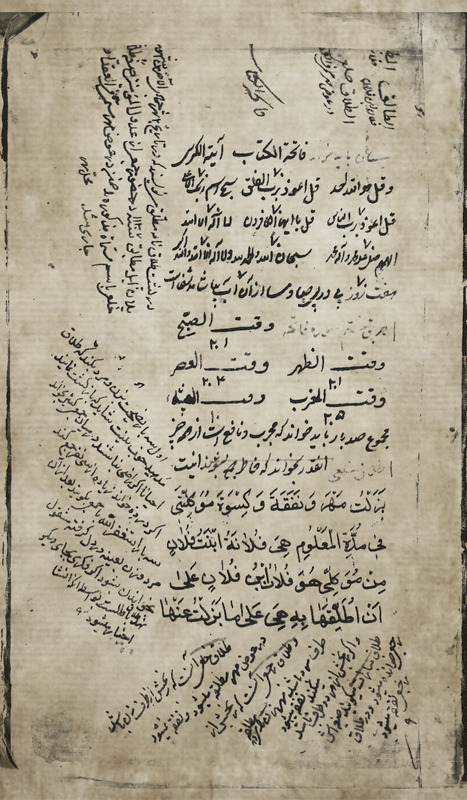
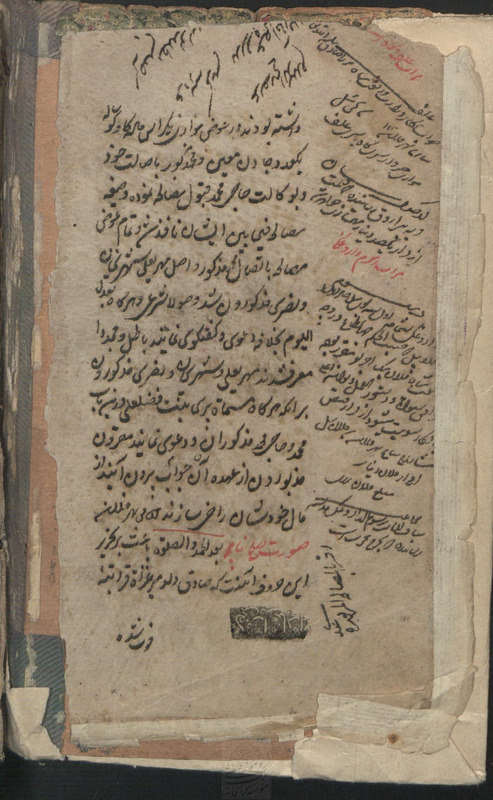
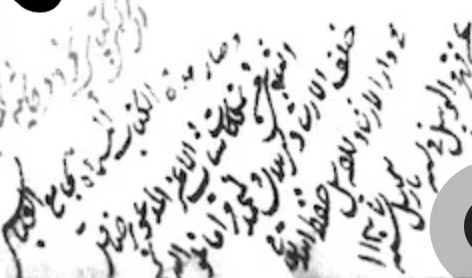
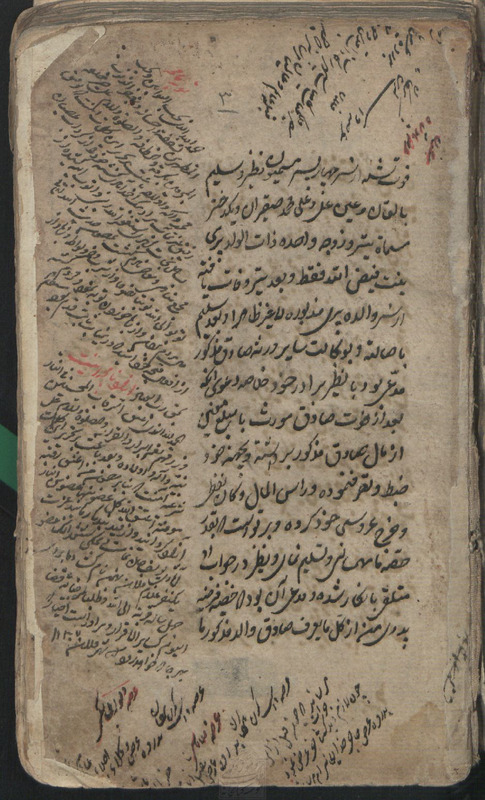
One anonymous owner records an inscription on the bottom left margin of Kazem’s text in red ink, probably dating to the 18th century, unambiguously describes habits of reading and writing in this anthology.
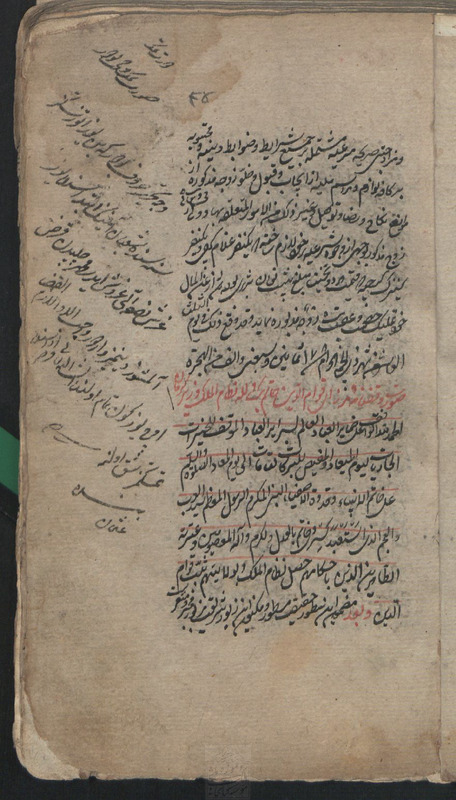
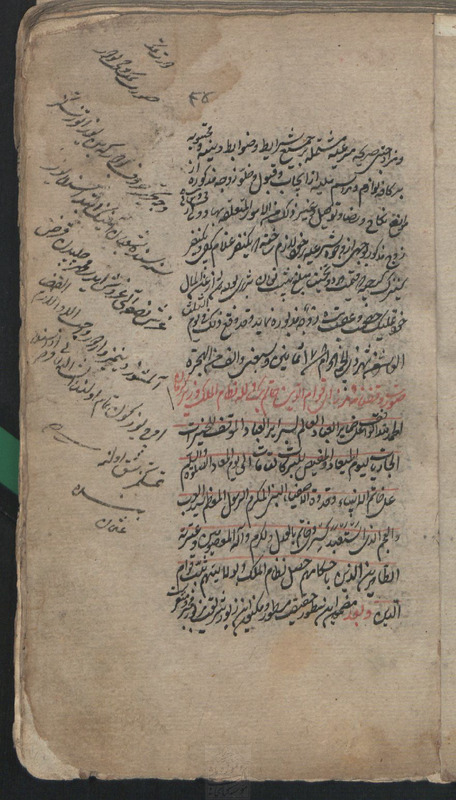
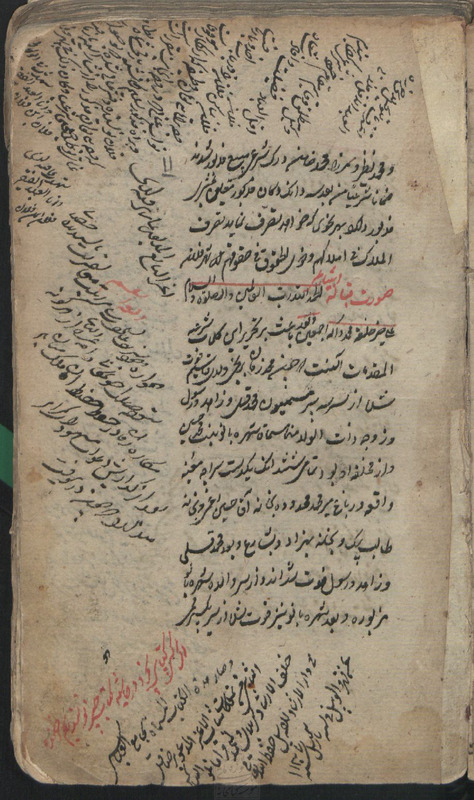
Confirmation Certificate (tasdīq-i daftari) Allowances (marsum)? The Year of the Ram, Hasan Jilūdār, who [entered] in a three-year contract? for the rent of a copper mine located in Buna Bar as delineated below, it is established that the bailiff (zābit) and the renter pay? the mentioned sum (vajh) in the customary manner. In such-and-such year the amount of such-and-such Tabrīzī Tūmān. Written? Such-and-such month of the year 1120 AH / 1708 CE.
Confirmation Certificate (tasdīq-i daftari) Allowances (marsum)? The Year of the Ram, Hasan Jilūdār, who [entered] in a three-year contract? for the rent of a copper mine located in Buna Bar as delineated below, it is established that the bailiff (zābit) and the renter pay? the mentioned sum (vajh) in the customary manner. In such-and-such year the amount of such-and-such Tabrīzī Tūmān. Written? Such-and-such month of the year 1120 AH / 1708 CE.
This was written in the month of Jumāda al-Awwal, the year of nine hundred and eighty-two [982 AH / 1574 CE] from the migration of the prophet, praise and commendation be unto him.
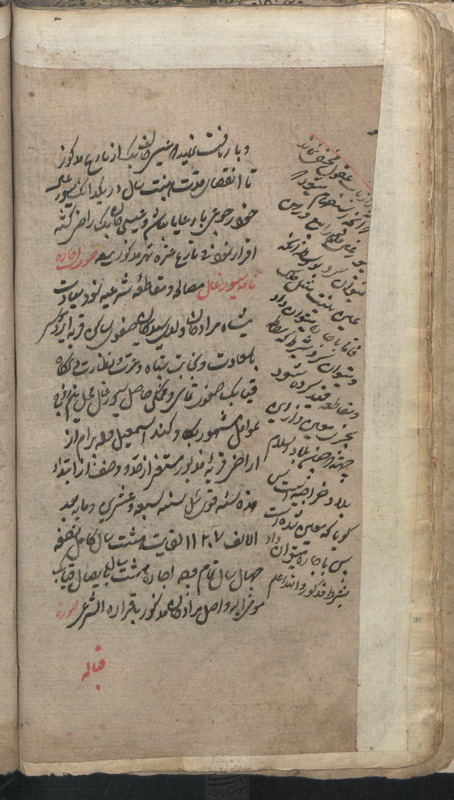
Copy (surat) of a promissory note (tamassuk) [in Ottoman Turkish]: This is a copy of a promissory note: The reason for the composition of letters is that we have debt [due to the fact that] in the beginning of the month of Shaban of the year 1138/1726 we borrowed from Meḥemmed Çelebi hundred ghurush, half of which is fifty ghurush. God—may [His name] be exalted!—willing, upon the payment of [the said] loan by the end of 300 days may our promissory note be halved [ ripped into two? destroyed?]. ʿOs̱mān, the servant.
Copy (surat) of rental agreement (ijāra nāma) of a Land Grant (soyurghāl) The Sayyid-sheltering Murād Khan son of Shayid-ī Khan Safavī resident of the village of Īrdmūsā legally (shar’ī) reconciled and contracted out to the felicity and nobility sheltering, dignity and guardianship outfitted Qīyā Beg Safavi the entirety and complete proceeds of [his] soyurghāl, the location [of which] is half a zawj [land that can be plowed by one bull each season] with the bulls (awāmīl) known as the bulls (gāv) ??? of Isma’īl [ or “known as the kavkand of Ismā’īl”] son of Barām, from the territories of the aforementioned village, that need not be described and bound, from the beginning of this year of the ram (qūy), 1127 AH / 1715 CE, for the duration of eight complete years to be received by the aforementioned Qīyā Beg as given by the aforementioned Murād Khan. [It is written] by his own legal acknowledgement.
Copy (surat) of rental agreement (ijāra nāma) of a Land Grant (soyurghāl) The Sayyid-sheltering Murād Khan son of Shayid-ī Khan Safavī resident of the village of Īrdmūsā legally (shar’ī) reconciled and contracted out to the felicity and nobility sheltering, dignity and guardianship outfitted Qīyā Beg Safavi the entirety and complete proceeds of [his] soyurghāl, the location [of which] is half a zawj [land that can be plowed by one bull each season] with the bulls (awāmīl) known as the bulls (gāv) ??? of Isma’īl [ or “known as the kavkand of Ismā’īl”] son of Barām, from the territories of the aforementioned village, that need not be described and bound, from the beginning of this year of the ram (qūy), 1127 AH / 1715 CE, for the duration of eight complete years to be received by the aforementioned Qīyā Beg as given by the aforementioned Murād Khan. [It is written] by his own legal acknowledgement.
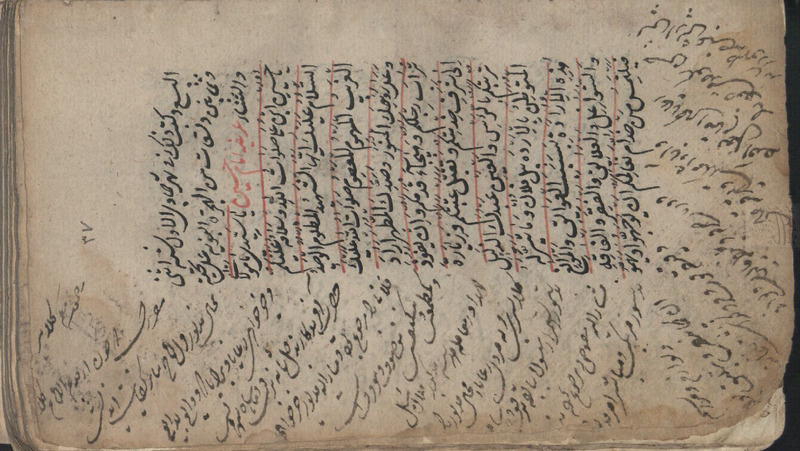
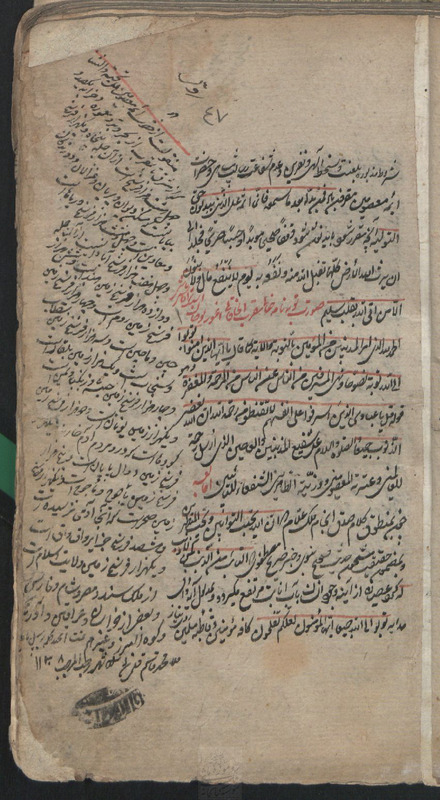
Copy (surat) of the endowment contract (waqf nāma) of Mirzā Qavām al-Dīn Hātam Beg father of Nizām al-Mulk the Minister of Kirmān Praise be to God who is aware of the thoughts (zamāyir) of his subjects, who knows their secrets and who is in charge of their good deeds that will endow continuous charities until the promised day (mi’ād) flowing (mufīz) with complete blessings until the Day of Judgment. Greetings and peace be upon the seal of prophecy and the exemplar of the pure ones [the Safīyya— alluding to the Safavids], the revered prophet, the grand messenger, the master (sayyid) of Arabs and Ajams, he who subjugated Khusraw (kasrā) and the ring/seal (khātam) with justice and generosity, and unto his innocent (ma’sūm) descendants and his pure (tāhir) family, the ones through whom kingship (mulk) was achieved and through their guardianship (wilāya) the stature of religion was registered. And now (va b'ad) the content of these truth-revealing lines and the secret of these law-describing writings [zabūr—lit. psalm], is reporting and examining
This was written in the month of Jumāda al-Awwal, the year of nine hundred and eighty-two [982 AH / 1574 CE] from the migration of the prophet, praise and commendation be unto him.
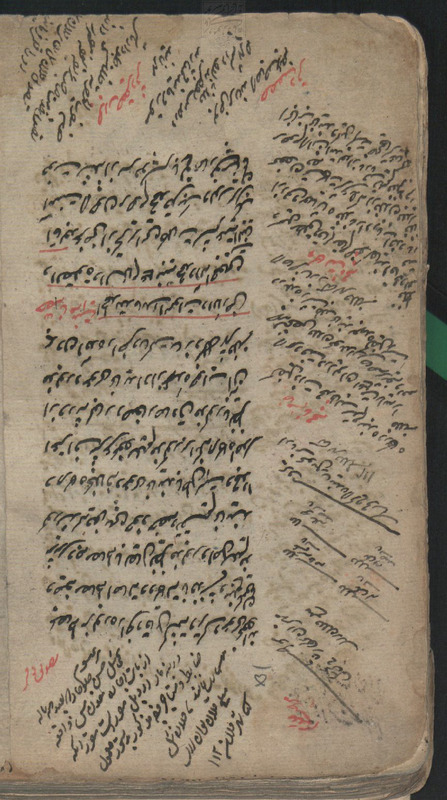
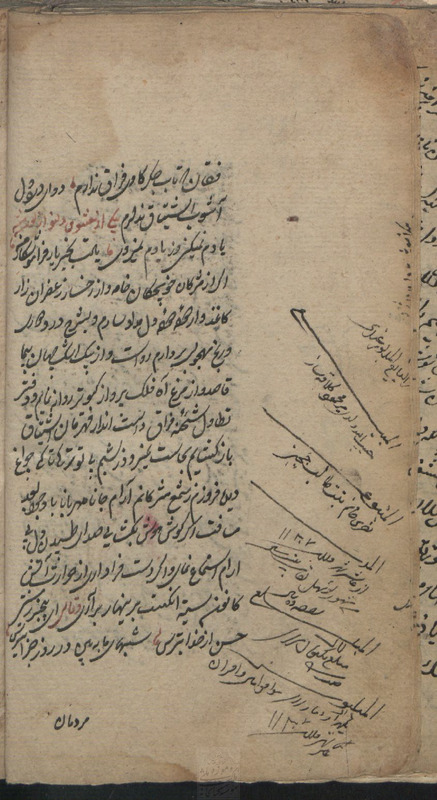
Draft (barāt) regarding fodder and hay Fodder The response to the holder of the office (sarkār) of vizier, the dignity sheltering Mirza Sadiq of ???? dated the month of so-and-so of 1130 AH (1718 CE) of the year of the ram (ki/qūy), equivalent to a donkey-load head of hay or a [donkey-load] head of fodder And give it to Piraruq whereby its price will be as agreed, one hundred Dinars ???
Draft (barāt) regarding fodder and hay Fodder The response to the holder of the office (sarkār) of vizier, the dignity sheltering Mirza Sadiq of ???? dated the month of so-and-so of 1130 AH (1718 CE) of the year of the ram (ki/qūy), equivalent to a donkey-load head of hay or a [donkey-load] head of fodder And give it to Piraruq whereby its price will be as agreed, one hundred Dinars ???
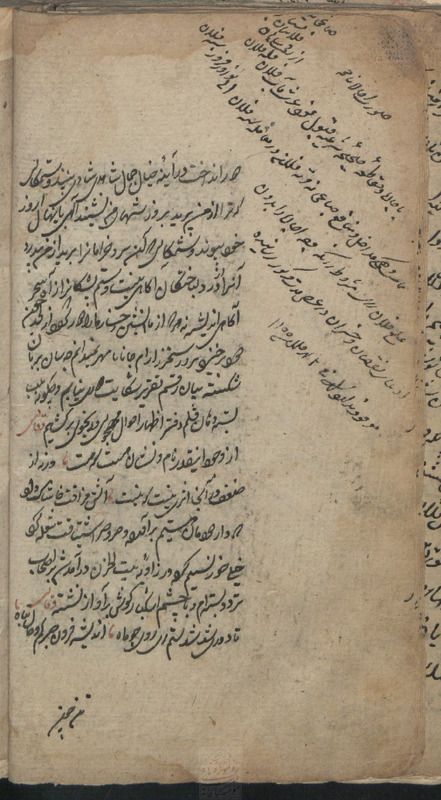
Freedom Papers (azād nāmcha) are as such:
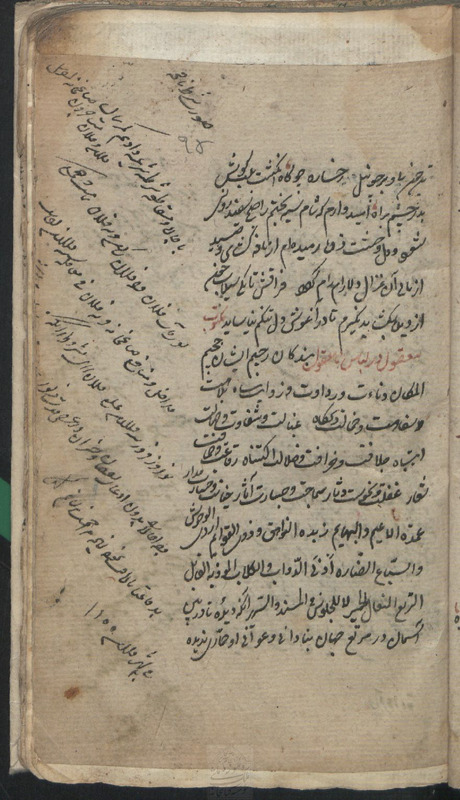
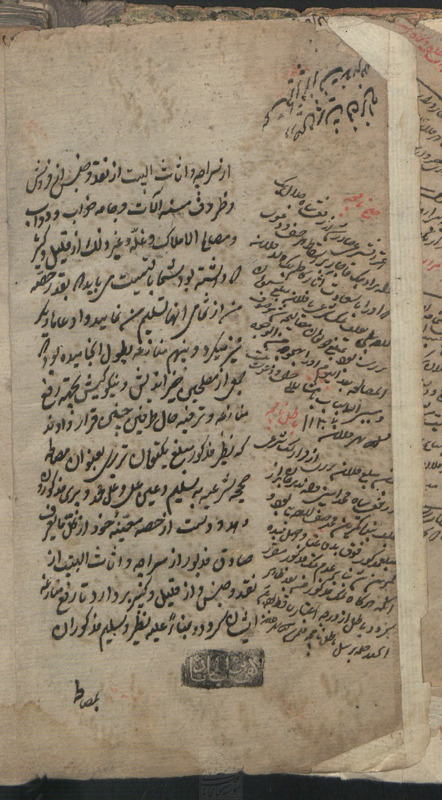
Praise be to Allah who protects the necks of the righteous ones from the fires [of hell] and provisions them with the choicest of virtues and strengths, and greetings and peace be upon his prophet and his kin and progeny. And then, the cause/reason for penning these legal [shar’iyya] words is that in accordance with the content of the Hadith “whosoever frees a believing slave, Allah will free all of his members, and their members, from the fire [of hell]”, ‘Izzat Ābādī Yusuf Khān freed and released from the yoke of bondage all the six-dāng members of one slave named so-and-so Bahman ?? for forty years?, to achieve closeness [qurba] to Allah and seek his contentment on the day of judgment as with other matters ??? and he [the slave] has control [ikhtiyār] to go wherever he desires. Written? Such-and-such month 1137 AH / 1725 CE
Freedom Papers (azād nāmcha) are as such: Praise be to Allah who protects the necks of the righteous ones from the fires [of hell] and provisions them with the choicest of virtues and strengths, and greetings and peace be upon his prophet and his kin and progeny. And then, the cause/reason for penning these legal [shar’iyya] words is that in accordance with the content of the Hadith “whosoever frees a believing slave, Allah will free all of his members, and their members, from the fire [of hell]”, ‘Izzat Ābādī Yusuf Khān freed and released from the yoke of bondage all the six-dāng members of one slave named so-and-so Bahman ?? for forty years?, to achieve closeness [qurba] to Allah and seek his contentment on the day of judgment as with other matters ??? and he [the slave] has control [ikhtiyār] to go wherever he desires. Written? Such-and-such month 1137 AH / 1725 CE
Peace Agreement (sulh nāmcha)
A legal confession (i’tirāf) was issued by the dignity-sheltering Jalāl Beg son of Murād Beg Qājār in nullifying any word or claim that he had made in relation to the felicity-effected Kāzim Beg son of so-and-so ?? a legal acknowledgment with so-an-so which was for the amount of three Tabrīzī Tūmāns was reconciled for the amount of two Tūmāns, as hereby described in the agreement. Henceforth, in no manner and for no reason will there be a claim or disagreement between him and the aforementioned. Written? such-and-such month, 1130 AH / 1718 CE
Peace Agreement (sulh nāmcha) A legal confession (i’tirāf) was issued by the dignity-sheltering Jalāl Beg son of Murād Beg Qājār in nullifying any word or claim that he had made in relation to the felicity-effected Kāzim Beg son of so-and-so ?? a legal acknowledgment with so-an-so which was for the amount of three Tabrīzī Tūmāns was reconciled for the amount of two Tūmāns, as hereby described in the agreement. Henceforth, in no manner and for no reason will there be a claim or disagreement between him and the aforementioned. Written? such-and-such month, 1130 AH / 1718 CE
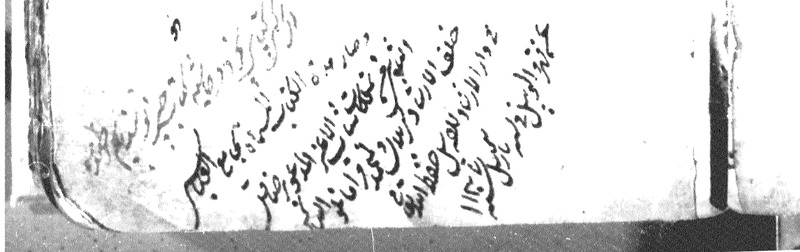
And this book, named the Jami’ al-Abassi, the second, came into the possession of an esteemed young man known as Rizā Qulī, the oldest of the sons of Karbalā’ī Valī Muhammad Qarāmānlū resident of the city of guidance, Ardabil, may Allah protect it [Ardabil] from oppression and hardship, in the year of panther [bārs] 1137 AH [1724 CE].