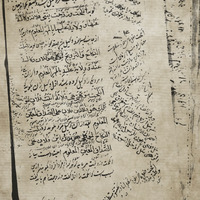
Malik 2551 folio 57 recto
- Folio (title)
- Malik 2551 folio 57 recto
- Translation
- Main: and if the father is the attorney of the daughter and performs the contract he says “I marry and give in marriage my daughter so-and-so, as I have agency on behalf of her and deputyship upon her, with a specified dowry”. And if the father acts as attorney on behalf of his son to perform the contract, he says “I accept the marriage and the contracting for my client, my son, who is so-and-so, and I have agency on behalf of him and and deputyship over him, with a specified dowry”. If the woman has an attorney and the man has another [attorney], first the attorney of the woman will say ,“I marry (ankahtu) my client who is so-and-so daughter of so-and-so, to your client, so-and-so son of so-and-so, with a specified and agreed upon dowry (saddāq).” And after this the man’s client says, “I accept the marriage (nikāh) on behalf of my client, so-and-so son of so-and-so, with the specified and determined dowry”. Caution dictates that either the term for marriage, “I marry” (ankahtu) or “I give in marriage” (zawwajtu), must be said individually and separately. Due to this, “I marry” (ankahtu) must be said first but “I give in marriage” (zawwajtu) must also be said Margin: ‘Aqd al-Khatt is the written marriage contract so that is what is being discussed but none of the sentences are complete enough to make sense]. 3 Know that caution dictates that the contract reciter says ‘for your client’ or ‘to your client’ or ‘of your client’, for example, after each recitation one should say. 4 “I marry (ankahtu)” is a present tense, singular, first person verb. Its meaning is independent of time, meaning that the present time is dropped from the meaning when it is written. …it is built on the notion of creation? …the marrying one (nākih) is placed… the speaker. And know that alif-lām has four types. The first type is the alif-lām of gender such as al-rajul–the man. The second alif-lām of preoccupation such as al-qusran al-insan–Human minors, the third is ali-lām of external covenant such as “But the Pharaoh disobeyed the prophet” (Qur’an 73:16) and the fourth is the mental covenant, for example, udkhul al-sūq–I entered the market. Inkahtu–I marry is a present tense, singular first person verb where ‘I’ is [hidden] in the conjugation form (mustatir). Its subject is the self and its object… My client…
- Transcription
- متن: و اگر پدر از جانب دختر وکیل باشد و صیقه بخواند چنین گوید انکحت و زوجت بنتی فلانه وکالة عنها و ولایه علیها بالمهر المعلوم و اگر پدر مرد از جانب پسر خود وکیل باشد صیغه بخواند چنین گوید که قبلت النکاح و التزویج لموکلی ابنی هو فلان وکالة عنه و ولایة علیه بالمهر المعلوم و اگر زن یکی را و مرد یکی را وکیل کرده باشد اول وکیل زن بگوید که انکحت موکلتی هی فلانة ابنت فلان لمو- کلک هو فلان بن فلان علی الصداق المعین المعلوم بعد از ان وکیل مرد بگوید که قبلت النکاح لموکلی هو فلان ابن فلان علی الصداق المعین المعلوم احتیاط است میانه انکحت و زوجت می باید که هر کدام فردا فردا بگویند ازین سبب است که انکحت را اول گفت و زوجت را هم باید گفت حواشی: …قه است … یک است و هیچ مفرد … مقدم است فلک؟ عقد الخط است باز … است چهار است یک ناکح است … است و یکصدا و مقدم است … الخط؟ است انکه ناکح است عاقد؟ است …ی و متعدی به با است … است تزویج متعدی مصر؟ است …ت مصداق مقدم … الخط؟ ۳ و بدانکه احتیاط انست که صیقه خواندن لموکلک و یا بموکلک و یا من موکلک بگوید مثلا از هر خواندن بگوید X ۴ انکحت فعل ماضی مفرد متکلم است معنای او منسلخ الزمان است یعنی زمان ماذیت؟[ماضیت؟] را انداخته اند قصد انشاء کردند X …مبنی احداث ایجاد است …[نا]کح واقع دارد؟ …متکلم و بدانکه الف لام بر چهار قسم است قسم اول الف لام جنس؟ مثل الرجل دوم الف لام استغراق مثل القصران الانسان سیم الف لام عهد خارجی مثل فعصی فرعون الرسول چهارم عهد الزهنی مثل ادخل السوق. انکحت فعل ماضی مفرد متکلم انا در تحتش مستطر فاعل او نفس؟ مفعـ[ول] موکلتنی مف …
- Item sets
- Folios
Part of Malik 2551 folio 57 recto