Search
104 items
-
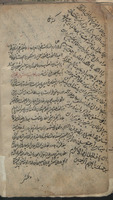
Malik 2551 folio 42 verso
Main: I have a heart shredded to pieces by sorrow, yet other than endurance what solution do I have? I hope that the absolving almighty will laud the efforts, compensate and reward the disheveled misfortune-afflicted (musībat zadagān) ones to help extinguish this soul burning flame with the waters of patience. Written in correspondence with the beloved: unequaled thanks befits the Powerful One (qādir) [i.e., God] who fosters the boxwood height of the cyprus-statured ones in the garden of freshness with pure water (tarāvat) and refinement (litāfat) raising them onto the banks of the river of grace (‘ināyat) and beauty (zībā’i). From the musk-scented ringlet and the ambergris-scented locks of the doe-eyed ones he ties a lasso around the neck of the rebellious ones with a calamitous trap and a chain upon the feet of the lion fighters (shīr afkanān). And … of the unbelievers (mushrik) Margin: soften…and so-and so upon me. O Allah …the sanctity of your grand name that is written upon the ring on the finger and body of Solomon (pbuh) so that he could become king upon all the world …make me sweet in the heart and eyes of so-and-so son of so-and-so. -
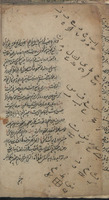
Malik 2551 folio 44 verso
Main: O how unfortunate are my ears [not to receive a word from you] and o how hapless are my lips [not to have a chance to converse with you]. Indeed the rose of the rosegarden of beauty and the candle of the well-mannered assembly have fulfilled the rituals of fidelity through which to hear the heart-burning story and the sorrow-filled narrative from this destitute one, this aching and helpless one will turn the dusk of his [my] existence into gold (zar khāhad sākht) through his alchemy-effecting (kīmīyā-asar) gaze (nazar). No excess of this will he be able to withstand the test of disappointment (butayih hirmān). Verse: O [beloved], without the flame of whose visage my eyes have no light, even if my life was leaving I would not be able to abandon you. Another entreaty is that Verse: do not take as partner another to share in your troubles, if being pretentious is the price of fame and beauty, one scandal suffices. The pen cannot withstand what the tongue narrates of separation and the speech of the pen itself does not have the power to write down the [sorrows] of desolation. Suffice it to say in brief these two or three words. Otherwise, Verse: From sorrow I have, o fairy-faced one, an eye and heart filled with fire. O Allah, o Allah, increase the illumination of the shadow-casting sun of your face as the disheveled shadow of the sun with locks of curly hair advances the progress of the smoldering tongues of flames of my sighs as the Euphrates-like spilling Margin: A B J D H W Z I W H 7 Ǝ H 8 H T I K L M N ~ lr ၈ ༦ H W H S ‘ F S Hhr H lb W Q R Sh T ᕙ H Kih I Th Kh Dh K II W D Z Gh N [+] La -
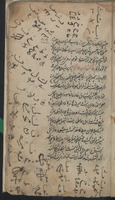
Malik 2551 folio 45 recto
Main: of the crying eyes. Verse: O Lord may it increase daily, my love and the beauty of that heart-pleaser. O life, o device, [verse] I wrote these two words (harf) in a manner no one else knows, because of your benevolence, read them in a manner only you know how. Written to One of the Beloveds (ma’shuq) - A disheveled nightingale who is deprived of [access] to the meadow, when will it have the image evoking eloquence of nightingales? Although the fear of the guardians of separation has placed a seal of silence upon the lips of the nightingale-voiced ones in the rosegarden of longing, yet the desire for imagining the sea, has given tongue to the hairs of the desert dwellers of the planes of bewilderment. They say: Every speck that I see, the tears for you are many. Every hair is a tongue complaining of your [separation]. How can I describe the severity (shiddat) of separation and express the intensity (hiddat) of the desire [for you/a union] when the water flowing from the eyes that are experiencing separation (hijrān dīda) will wash off the pages and the fire emerging from the chest that are experiencing parting (farāq kashīda) will burn the pen. They say: ?? the parrot-like pen describing the desire, [is] also the heart that is with you! One by one they discuss that [ever since I was separated] from the honor (sharaf) of your union Margin: A B T Th I yn X ۳ J H Kh D Dh هی ها g E [ R Z S – ی m Sh S D F ⤧⤑ ع T Z ‘ Gh F Q G FF 8 I Ǝ lr K L M N Ii ☋ ‘ ♆ Hi V La I B T Th H Kh D R Z S Sh S D T Z ‘ Gh F Q K L -
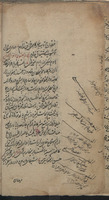
Malik 2551 folio 46 verso
Main: Woe that I do not have the endurance to withstand the heart wounding pain of separation, or possess the cure for the heart-bewildering pain of desire. Written to One of the Heart-pleasing Beloveds (ma’shuq) You do not think of me but will not leave my thoughts, I think of you well (bih khayr) my forgetful lover. It would be befitting were I to make stylo from my blood-dripping lashes, paper from my saffron field-like yellow face, and pencil from the ashes of the heart, so that I could engage in describing the details of the pain of separation and the toils of abandonment. It will [further] be permissible should I make a messenger (qāsid) from the arrows of the world-travelling tears and a pigeon from the heaven-traveling birds of my sighs and send [this message] to open the notebook of tyranny of the soldiers of separation who will cause hindrance to the champion of desire. My nights will not pass without you, o beloved [??]; for how long must I light my eyes with the flame of my lashes? O calm of my soul, o kind one! In spite of the depth of distance between us, were you to open your ears of wisdom, you will hear the sound of the beating of this restless heart and if you bring your hands close, you will recoil your fingers in warning from the heat emanating fire inside the hearth of the heart. They say: O one who is unaware of the drunkenness of beauty, fear God; observe our nights and fear the day of judgement Margin: The aforementioned seller was acknowledged by me. The Sale Habīb-ullāh son of Mir Mahmud-i Kalāqa-Sāz The Buyer Lady Fakhrī daughter of Tālib Jahnī Duration From the tenth of the month of so-and-so of 1137 AH [1724 CE] from amongst the months of the year of the whale (lūy) from twenty years, half of which is ten years. The Price of Property For the price of one Tabrīzī Tūmān It’s finished The ? One thousand Tabrīzī Dīnārs as per Amīn and Iqrān [signed] in the month of so-and-so of 1137 AH [1724 CE] -
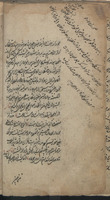
Malik 2551 folio 47 verso
Main: May the heart that separated me from you not find happiness in the mirror of imagination that witnesses the beauty of the beloved. And may the oppressor who cut me off from you not be subjected to the same nights as I have experienced. O Lord, either rejoin yourself that sapling of desire?? The oppressor who cut me off from that proud cyprus ... Those without pain have no knowledge of the pain of those who lost their hearts and those on the path of injustice have no thought for the sighs of the informed ones. May whoever cast us far from the ??? of that face rise from the grave like a smoke on the day of judgement. O comfort of my soul, I do not know how to describe the lamentations of separation with the broken tongue of the speech of script, and how to open the book of the conditions of separation and pain with the closed lips of the mouth of the pen. They say: From His existence there is ample name and lineage (nām u nishān) [to show] that he exists; in fact there is no sign of weakness there because he is not [weak]. The fire of your separation has produced the foundation for our household (dudmān) and the wind of your desire has caught flame and has given me a good share [of it]. In the corner (zawīya) of the house of sorrow I await the [promised?] song with tearfilled eyes. They say: O moon-faced one [beautiful one], once separation occurs, I have come to possess excessive thoughts, diminished patience, and ruined conditions Margin: Copy of a Rent Agreement (ijāranāmcha) The heavenly-abode one so-and-so son of so-and-so agreed to rent from and enter into a legal and correct contract with elevation sheltering one so-and-sos [renters] Wool-dyeing (sabāqkhāna) the entirety and all of the proceeds and revenue of the wool-dyeing shop of the so-and-so village in the contract of such and such year until the Nawrūz of the such-and-such year for the price of such-and-such Tabrīzī with the condition that the price of rent be paid without any claims to deficiency and loss in the aforementioned duration and not be halted. [written] on the second of so-and-so month of 1155 AH [1742 CE] -
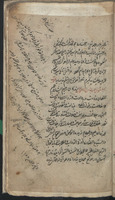
Malik 2551 folio 48 recto
Main: I have a body like reed, a face [wet] like the Nile, cheeks [yellow] like straw, with my finger of bewilderment on my lip, my ears waiting to hear a sound at the door and my eyes staring at the road [awaiting your arrival]. I hope that the black night of my fortune will be illuminated by the white morning and my scared and frightened heart be tamed (rām) by the opening of the belly [making aromatic the air] and the testing of the hunting skills performed by that heart-pleasing gazelle. I will not [accept] the separation until floods of blood spill from my eyes, nor will [it subside] until he settles in the embrace of my tightly squeezed heart. A Reasonable Letter in an Unreasonable Attire - His cursed (rajīm) subjects (bandigān), are the grand-stationed ones, the lowliness (dinā’at), ??, and ?? sheltering, stupidity, foolishness, and ??? outfitted, ???, wretchedness, and ignorance vigilance, ???, thickheadedness, and stupidity scrutinizing, ?? and stupidity sloganed, neglect and ominous clothed, insistent and bravenous traced, treachery and loss versed, elder amongst cattle and animals, the top amongst the braying and the strong ones??? of harmful beasts and wild animals, lowest of the animals and annoying dogs, valued at quarter of a donkey, not worthy of sitting on a throne or a seat, the one that the rare-finding eye of the heavens has not seen a donkey as unlearned and encaged?? as him Margin: Copy (surat) of a Condition Letter (shart nāmche) We rented out and entered into a legal conditional contract ?? so-and-so the renters of the Luy-yil wool-dyeing shop (sabāghkhāne) ??-like so-and-so son of so-and-so resident of the village of so-and-so all and the entirety of the proceeds and revenue of the wool-dyeing shop of the village of so-and-so in contract from the year such-and-such until the Nawruz of the year such-and-such for the amount of such-and-such Tabrīzī on the condition that the price of rent be paid without any claims to deficiency and loss in the aforementioned duration be every time received and paid out and sent. On 20 of so-and-so month of 1155 AH [1742 CE] -
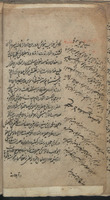
Malik 2551 folio 48 verso
Main: and the wondrous-hearing ear of the ages has never heard a sound like his irritating voice. The one who has not but for a second, even as a result of the sighing of the afflicted and the cursing messages of the dispossessed, stopped the onslaught and attack of his perfidious nature and the ravishing of his tyrannical role and instead wonders (andīshad) and recklessly breaks the glass of honor of the masters of dignified character (sāhib sīratān-i vaqā’) and the reward (waza) of the good name (nīknāmī) of the chaste ones with the stone of a defaming accusation; the one who, in the duration of his undesirable life never veered off the path of a biting dog (‘aqūr) or a scorpion (‘aqrab), always injuring the insides of the masters of heart with a poisonous sting; the one whose un-praiseworthy (nā-mahmūd) existence is the denial of the ban on oppression (bagha) and rebellion (‘usyān) and whose undignified person is the source of deceit, artifice, and ??? He is the fame of whose justice and equity has enslaved Hajjāj and Shaddād and the words of his righteousness and justness, has inflicted Abu-Lahab with envy and bewilderment. The collection of reprehensible qualities, entailing bad actions, higher? than Saturn in the ominous skies??? Margin: In order to verify the condition of the one who is absent Write this shape and place it under the head then sleep. If you see the absent one sleeping, he is dead. If you see the absent one sitting (??), he is dead. If you see the absent one sitting he is alive and if he is standing he is on the road [to you]. The shape is: THH LA MQSLH SQTMA’ For a sick person, place the hand on the head of the sick person and recite it. God almighty will cure the sick person, by the aid of God Almighty. ?? O Lord… The great Lord of the great threshold, Who knows … From the damage of the fire [of hell]. Whoever recites these four names twelve times will become mighty [and wealthy]. O the strongest, O the wealthiest, O… O the Most Faithful. The End -
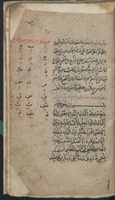
Malik 2551 folio 49 recto
Main: corruption, stupidity, cruelty, baseness, ignorance, idiocy, superstition, and sourness, Khwaja Karr’a-al-Din Saylaqā, eternally has established dominance (mutamakkin) over the throne of shaky (tazalzul) affairs (hāl) that has shattered (tawazzu’) the mind (bāl). May the farm of his desires be ever verdant (sarsabz) from the electric fire of the steam of sighs of regret (hasrat), may the rosegarden of his prosperity (iqbāl) be in bloom from the poisonous winds of the meadow of disappointment (hirmān). May ill anger (khashm-i bad) not reach the development of the weeping willow of the garden (hadīqa) of his fortune (dawlat). This is the ‘Adliyya Prayer In the name of God the Compassionate the Merciful God is the witness that verily there is no God but him and the angels and the masters of knowledge (ūlū-l-’ilm) are based on just distribution. There is no God but the Almighty, the Wise. Those who are with Allah are Muslims and I am the weak, sinful, transgressing, unworthy, needy, poor subject. I bear witness to my benefactor, to my sustainer (rāziq), my creator, my honorer (mukrim), as he bears witness Margin: Fire letters Air lets. Water lets Earth let. A B J D 1 2 3 4 H W Z H 5 6 7 8 T Y K L 9 10 20 30 M N S ‘ 40 50 60 70 F S Q R 80 90 100 200 Sh T Th Kh 300 400 500 600 Dh D Z Gh 700 800 900 1000 The End -
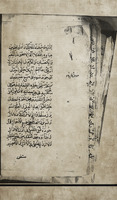
Malik 2551 folio 49 verso
Main: to His essence (zāt) and the angels and masters of knowledge from amongst his subjects (‘ibād) bear witness to this, for there is no god but He, the possessor of blessings (na’am), benevolence (ihsān), generosity (karam), and gratitude, the all-powerful eternal, ever-knowing, ever-living, the One, the Awakened (sahad), the Existent, the Witness, the All-Hearing, the All-Seeing, the All-Aware, the One who achieved (mudrik) steadfast (samad), He is worthy of these attributes. What is He in the glory of his attributes? He was all powerful even before the existence of His power and might, and He was All-Knowing even before the creation of knowledge and cause. He has always been sovereign, though there was neither kingdom nor wealth and He has always been glorified in all circumstances. And, His existence (wūjūd) preceded all else in eternity, and His perpetuity endures beyond all distance without transition or cessation. He is steadfast in the beginning and the end Margin: Mahlu? Number / work? -
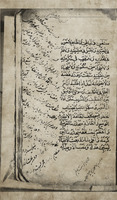
Malik 2551 folio 50 recto
Main: He is free from a need (mustaghin) for an inner essence (bātin) and an outward appearance (zāhir). There is no injustice in his judgment and no bias in his path. There is no oppression in his decree (taqdīr), and his dominion (hukūma) is unavoidable. There is no refuge from his might, nor any escape from His judgement. His mercy precedes (sabaqat) his wrath. No one escapes Him when He seeks them. He removes (azāha) obstacles from the command and ensures harmony (sawaya) between the weak and the noble enabling (makkana) the fulfillment of the mandated duty and has made the path easy (sahhala) to avoid transgression. No obligation (tā’a) is fulfilled without his expansive power and energy (tāqa). Glorified be He, how exalted is his bounty (nayl) and how great his benevolence (ihsān). Glorified be He, how evident is his generosity (karam) and how lofty is his status (sha’n). He sent the prophets to demonstrate His justice and appointed the guardians (awsīyā) Margin: Description (shart) of the Great Love Charm (dilband-i azim) It has come down to us that this prayer is a great heartbinder. If you wish to make someone love you such that they cannot find comfort without you for one hour or even one second, such that day and night are the same for him [for] the bright day is dark and narrow for him and… be tight/closed/fastened on his seven limbs, [recite] this forty … there is no doubt. And if you write the knot of love with musk and saffron and rosewater or written on a clean … [fine quality?] paper and placed [to preserve] in wax and keep with himself to… so that all the qualities of this prayer are preserved. And if … keeps it, there is fear of death and if … writes it and with … keeps it, be … in love from … it will have a great effect on love. It is tested. Allah is all knowing! Jahan Banu, daughter of Kazim for the love filled prayer of this Shaykh? -
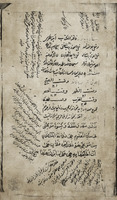
Malik 2551 folio 54 recto
Main: [In the Water of] Naysan Must be Drunk – The opening Chapter 7, the Throne Verse (Ayat al-Kursi) 7, “And Say He is Allah, the one and Indivisible” 7, “And Say I seek refuge in the Lord of the dawn” 7, “Glory be the name of your Lord, the Most High” 7, “Say, I seek refuge in the Lord of mankind” 7, “Say O you the disbeliever” 7, “There is no God but Allah, Greeting be to Muhammad and his kin, Glory be to Allah, Praise is for Allah, there is no God but Allah, Allah is the greatest” 7. If he drinks it morning and evening (sabā va masā) for seven consecutive days, it will bring healing. How to recite the Fatiha (first chapter of the Quran) – in the morning 21, at noon 21, in the afternoon 24, in the evening 25, at night 10. Altogether must be recited one hundred times as has been tested (mujarrab) and is beneficial for all things. Discharge (khul’-i) divorce – It must be recited until they are convinced it is correct I have provided her with the dowry (mahr), maintenance (nafaqa) and clothing (kiswa) for a specified period. She is so-and-so, daughter of so-and-so and my client is so-and-so, son of so-and-so. If he divorces her, she shall remain subject to the provisions I have provided for her. Margin: Divorcee divorcee So-and-so son of So-and-so daughter … So-and-so Discharge divorce In exchange for the dowry as stated in the marriage contract… The First Chapter of the Quran (Fatiha) Write on the reverse side of the divorce contract of the divorcee: on the date of 20 of Jamadi al-Akhar from the months of the Year of the Snake, which is 1137, in the presence of a number of trustworthy Muslims, the discharge (khul’) divorce formula was affixed in the name of the aforementioned woman, in exchange for the dowry as mentioned in the marriage contract. Place of the Seal First, advise the man and woman three times that they should not divorce for it is not a good deed. Perhaps this way they will reconcile if by chance they are not in agreement with divorce. It [the divorce contract] should be recited in a large gathering. If they are in a village, more than thirty people should be assembled. Say “I seek forgiveness from God (astaghfir allah)” three times with the group. After that the man and woman should both, with sincere hearts, begin to recite. If his thoughts go elsewhere the divorce is void because of it. Discharge (khul’i) divorce is where the unhappiness is on behalf of the wife and she gets a divorce in return for her dowry. There is no maintenance (nafaqa). And a reversal (raj’i) divorce is where the unhappiness is on behalf of the man and he will pay the dowry and become divorced. There is maintenance. If the unhappiness is mutual it is called matching (mubarat) divorce. Its contract is recited like a revocable one and likewise has maintenance. -
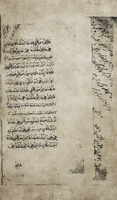
Malik 2551 folio 54 verso
Main: My client, so-and-so daughter of so-and-so, is divorced. She is divorced-one divorce (talaqat). She is divorced, once (marratan). And if the divorce is only in exchange for the dowry, then the maintenance and clothing cost and duration does not need to be stated. I hereby pronounce my client's divorce: so-and-so daughter of so-and so, from my client so-and-so son of so-and-so, must divorce her as I have pronounced. My client so-and-so daughter of so-and-so is hereby divorced. She is divorced, she is divorced, she is divorced, once, she is divorced once (marratan). And if the man gives the woman the dowry, for example if her dowry is ten Tumāns and he gives her ten Tumāns in cash and with witnesses, then he says: I hereby pronounce the aforementioned woman, my client so-and-so, the daughter of so-and-so, to be divorced from my client, on the condition that he divorce her. She is hereby divorced from my client, so-and-so, the daughter of so-and-so. She is divorced. She is divorced. She is hereby divorced (talaqat). Margin: From so-and-so son of so-and-so as named in the contract -
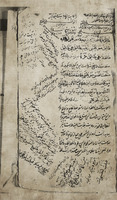
Malik 2551 folio 55 recto
Main: She is divorced once (marratan). Reversal (raj’ī) divorce – The wife of my client so-and-so is divorced, my client Zaynab is divorced, she is divorced, she is divorced once. She divorced once. Temporary [marriage] contract – Know that in the temporary [marriage] contract the duration and the amount is stipulated. So the attorney of the woman should say: I temporarily marry the person of my client, so-and-so daughter of so-and-so, to my [other] client, so-and-so son of so-and-so, from now until the dawning of the sun for the price of four ewes (?). The attorney of the man says I accept it for my client. ??? – From amongst the narratives and sayings of the masters one is that a permanent marriage, not temporary (mut’a), is written as marriage (nikāh) or betrothal (tazwij). Both can be used and our previous masters, may Allah be pleased with them, objected to both terms. Extreme caution is prescribed. The majority of the learned, in whose service we were fortunate to have been, observed that both verbs are made transitive by using the preposition ‘from’ (man). In the dictionary Margin: [counterclockwise from top] The steadfast and noble, exalted dignitary Allahverdi Khan son of the deceased Isa Khan Safavi Attorney in ??? Claimant to extend the lasting of his eternal fortune, the author of these words, Muhmmad Zaman Amount Five thousand Tabrizi dinars … The chaste (bākira) Parizad Khanum, Daughter of Husayn Tabrizi Attorney ??? Claimant so-and-so Date 24 month of such-and-such 1102 Duration 12 years Reversal Divorce I married my client… He divorced so-and-so daughter of so and-so so-and-so son of so and-so so-and-so divorced and Divorced, divorced her one time. Musabiya? Know that the temporary [marriage] contract has no divorce but it has ‘idda [duration of pause for woman before she can marry again] and its ‘idda is one [period] bleeding. If there is no bleeding, then forty five days from ??? one year. If the man commits to [reciting] the contract himself and the woman also serves as her own attorney, this is what he will say: I marry the person on my client, etc. Know that in a temporary [marriage] contract the condition is the designated length and the acknowledged amount. If the woman had made someone her attorney and the man made another his attorney, first the woman’s attorney says I temporarily marry (muta’tu) the person of my client Zaynab to your client Muhammad from now until the dawning of the sun for [the price of] four ewes [translation in persian underneath: Meaning, I married temporarily the person of my client who is Zaynab to the person of your client who is Muhammad from now until the dawning of the sun…] and the man’s attorney says: I accept it for my client. Fin And if the man tends to? the marriage contract and the woman … to him… [says:] I married the person on my client Zaynad from now until the dawning of the sun for [the sum of] four dinars [under each line translated in Persian: I temporarily married the person on my client who is Zaynab from now until the dawning of the sun for [the sum of] four dinars]. The man says: I accept it for myself [under the line in Persian: I accept it for myself]. End -
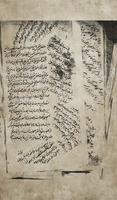
Malik 2551 folio 56 recto
Main: it is a transitive verb and the object is a person. In the noble Qur’an, marriage (nikāh) in various locations is written as transitive with the object being a person, for example in the verse: “I wish to marry one of these two daughters of mine to you” (Qur’an 28:27) meaning that I will marry to you, one of these two girls. Here the attached pronoun “to you” (-ak) is the direct object and “one of these two daughters” is the indirect object. Betrothal (tazwij) is also in many places made transitive with a person as the object. Like when God says “I paired her with you” (33:37) meaning that I married that woman to you. In other places it is made transitive with an object “We will pair them to [women with] beautiful eyes” (55:54) meaning that I married them to the beauties who have beautiful eyes. And this ?? After looking and searching in many narratives I noticed that the transitive verb is often paired with ‘from’ (man) taking extreme precaution necessitates that all of these conditions be carried out. Also in the verses aforementioned, the name of the man precedes the name of the woman but is conversely known (??). So if both could be observed it is best and most cautious. Also the fluid? view of the narratives and saying is that if the girl (dukhtar) has reached the age of reason and is chaste [a virgin], only her agreement is needed and also only the agreement of the women (zan) is needed, even if she has a father and a grandfather Margin: Sarlik [folded?] Prayer – Write for ??: “Indeed, those who believe and do good will have the Gardens of Paradise as an accommodation, where they will be forever, never desiring anywhere else.” (Qur’an 18:107-108) End Marriage Verse (khutba) – 1 Praise be to Allah who made lawful marriage and forbade adultery and illicit intercourse. May Allah send blessings to Muhammad and his good, pure, and innocent descendents, by His mercy, the most Merciful, the most Benevolent. After this, begin reciting the contract Chapter – Write for ??: I ask of you by your name, Oh Lord I have vowed to you… my inside [the child inside me?] that is dedicated [to you], so accept it from me for you are… and Oh Lord, there is no God but you. End “Then We caused the earth to swallow him up, along with his home. There was no one to help him against Allah, nor could he even help himself.” (Qur’an 28:81) Chapter – And write over it for?: It has been tested. The heart fluctuates and moves. “Or have they mastered some plan? Then We are surely planning. Or did they think [it]”? (Qur’an 43:79-80) and there is no power and no strength except by Allah and … The marriage (munākiha) took place between the two parties, the offer and the acceptance. And I am from the side that made the offer… ? first of the Sayyids. 2 It is narrated by the prophet, blessing of allah be onto him, he prohibited putting hands on someone, hanging one’s head, looking into the sky, placing one’s hand between the knees, closing one’s eyes, placing hands on the neck, and yawning; the prophet spoke the truth. The marrying party (nākih), so-and-so son of so-and-so The attorney, so-and-so son of so-and-so The married one, so-and-so daughter of so-and-so Her attorney, so-and-so son of so-and-so With the dowry ?? Toman Date 2 month of such-and-such 1103 AH [1691-1692 CE] [torn] Permissible… Place of seal -
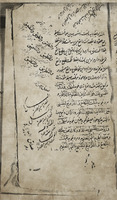
Malik 2551 folio 56 verso
Main: and it should also be known that it is well established among scholars that the sigheh contract must be performed with the intention of creating a contract. For example, the person who utters the words “I marry” (inkahtu), if the intention is that no marriage has taken place before this, or if the intention is that the marriage is being contracted by the words “I marry” the marriage will in fact take place. Meaning that he is saying “I make this contract now” and the marriage is thus concluded. And know that if the man and the woman perform the marriage contract themselves [without representation] and the woman has no attorney, first the woman says “I marry to (inkahtu) and betroth (zawwajtu) myself to you with a known and aforementioned dowry (saddāq)” and the man says “I accept the marriage to and betrothal for myself with the known and aforementioned dowry”. If the woman has an attorney and a guardian (wali) and she herself says the nika, she should say: “I marry and give myself on the authority (isālatan) and deputyship (wikālatan) of my grandfather and father, for the specified, aforementioned dowry (mahr)” and the man says “ I accept the marriage to and nika for myself for the specified, aforementioned dowry” Margin: The marriage (munākiha) took place between the two parties, the offer and the acceptance. And I am from the side that made the offer… ? first of the Sayyids. 2 It is narrated by the prophet, blessing of allah be onto him, he prohibited putting hands on someone, hanging one’s head, looking into the sky, placing one’s hand between the knees, closing one’s eyes, placing hands on the neck, and yawning; the prophet spoke the truth. The marrying party (nākih), so-and-so son of so-and-so The attorney, so-and-so son of so-and-so The married one, so-and-so daughter of so-and-so Her attorney, so-and-so son of so-and-so With the dowry ?? Toman Date 2 month of such-and-such 1103 AH [1691-1692 CE] [torn] Permissible… Place of seal -
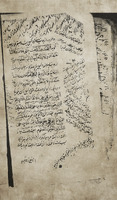
Malik 2551 folio 57 recto
Main: and if the father is the attorney of the daughter and performs the contract he says “I marry and give in marriage my daughter so-and-so, as I have agency on behalf of her and deputyship upon her, with a specified dowry”. And if the father acts as attorney on behalf of his son to perform the contract, he says “I accept the marriage and the contracting for my client, my son, who is so-and-so, and I have agency on behalf of him and and deputyship over him, with a specified dowry”. If the woman has an attorney and the man has another [attorney], first the attorney of the woman will say ,“I marry (ankahtu) my client who is so-and-so daughter of so-and-so, to your client, so-and-so son of so-and-so, with a specified and agreed upon dowry (saddāq).” And after this the man’s client says, “I accept the marriage (nikāh) on behalf of my client, so-and-so son of so-and-so, with the specified and determined dowry”. Caution dictates that either the term for marriage, “I marry” (ankahtu) or “I give in marriage” (zawwajtu), must be said individually and separately. Due to this, “I marry” (ankahtu) must be said first but “I give in marriage” (zawwajtu) must also be said Margin: ‘Aqd al-Khatt is the written marriage contract so that is what is being discussed but none of the sentences are complete enough to make sense]. 3 Know that caution dictates that the contract reciter says ‘for your client’ or ‘to your client’ or ‘of your client’, for example, after each recitation one should say. 4 “I marry (ankahtu)” is a present tense, singular, first person verb. Its meaning is independent of time, meaning that the present time is dropped from the meaning when it is written. …it is built on the notion of creation? …the marrying one (nākih) is placed… the speaker. And know that alif-lām has four types. The first type is the alif-lām of gender such as al-rajul–the man. The second alif-lām of preoccupation such as al-qusran al-insan–Human minors, the third is ali-lām of external covenant such as “But the Pharaoh disobeyed the prophet” (Qur’an 73:16) and the fourth is the mental covenant, for example, udkhul al-sūq–I entered the market. Inkahtu–I marry is a present tense, singular first person verb where ‘I’ is [hidden] in the conjugation form (mustatir). Its subject is the self and its object… My client… -
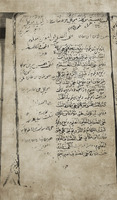
Malik 2551 folio 57 verso
Main: again the woman’s attorney says “I wedded (zawwajtu) my client who is so-and-so daughter of so-and-so with your client, so-and-so son of so-and-so, with a specified and determined dowry (saddāq)” and the man’s attorney says “I accept the marriange (tazwij) on behalf of my client, so-and-so son of so-and-so, with the specified and determined dowry”. A prudent person will again repeat “I marry” and “I pair with”. The woman’s attorney says “I marry to (ankahtu) and betroth (zawwajtu) your client, so-and-so son of so-and-so, my client who is so-and-so daughter of so-and-so, with a specified and determined dowry (saddāq)” and the man’s attorney says “I accept the marriage (nikah) and union (tazwij) on behalf of my client, so-and-so son of so-and-so, with the specified and determined dowry”. The written (bi-khatt) contract is as such – I marry to and pair with so-and-so for a specific and determined dowry Margin: He married the [female] client who is so-and-so daughter of so-and-so to the client’s client? and he is so-and-so son of so-and-so, for a specified and determined dowry [describes the parts of speech in Arabic] I marry and pair with [describes the parts of speech] I marry the person of client’s client who is so-and-so son of so-and-so for the clients client who is so-and-so daughter of so-and-so for a dowry [describes the parts of speech] I accept the marriage… and she is so-and-so daughter of so-and-so for my client’s client who is so-and-so son of so-and-so for a known and determined dowry -
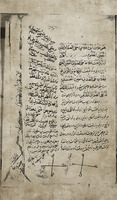
Malik 2551 folio 58 recto
Main: he is so-and-so son of so-and-so, for a specified and determined dowry. The written (bi-khatt) agreement (‘aqd) is recited as such – “I marry to (ankahtu) and betroth (zawwajtu) so-and-so for a determined and specified dowry (saddāq)” and the attorney of the man says “I accept the marriage and betrothal to so-and-so for a specified and determined dowry”. Also, in the contract of the settled agreement it can be [written] as such “I accept the marriage to him for an aforementioned dowry” without mentioning the name of the man. END And know that – Whatever word is said first in the invocation, it should be used first in the acceptance. For example, if the woman’s attorney says “I marry (ankahtu)”, the man’s attorney also says “I accept the marriage (nikah)”. And if the woman’s attorney says "I marry (ankahtu) and I betroth (zawwajtu)”, the man’s attorney also says “I accept the marriage (nikah) and union (tazwij)”. And the same applies to its transitive qualities. It is also a condition that at the time of the declaration, two just men or a group of witnesses who know the woman be present so that they know that it is her who is speaking the words and not someone else for the time of bearing witness Margin: For Capturing Someone's Heart Whoever desires is to possess someone… Pray two rak’as and recite the Fatiha chapter completely, and seven times… perhaps Allah will reconcile between you… those you have been hostile toward… and God is all powerful and all absolving… and when He greets, He will say seventy-seven times: O Allah, may the heart of so-an-so soften [for me] as the iron softened for David. So if you do this, that person will be possessed by him [you?] and he will be submissive in a way that cannot be imagined. This is the rendering for spleen Write this rendering and place it on an unwashed … and place the spoon above the spleen while the shirt is pulled to above the spleen… burn the written rendering inside the spoon such that… the spoon is not burned at all and the spleen… burns. It is tested (mujarrab). The shape is as such. [a plus made of two long kāfs] Also it is tested that the shape is written with ayn. [a plus written with two long Ayn’s] -
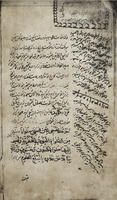
Malik 2551 folio 58 verso
Main: they can bear witness. And when acting as attorney and reciting the contract, [the attorney] must determine the dowry (mahr): whether the gold is in coins or used currency; whether it is nine and half dāngs or ten dāngs. And whoever is the attorney on both sides must be versed in Arabic so as to distinguish between signs (‘alāmat) and vocalizations (‘arāb) and be able to pronounce terms correctly. He must correct his accent with the [help of] the Qur’an reciter (qārī) who can properly pronounce the words based on the output [the desired meaning?] and also knows when to pause and when to connect the words. The translation for the marriage contract is as such – for it to be without a mediator as said by God and in accordance to the tradition of the prophet. I gave as wife (zanī) and as husband (shawharī) whoever has hired me as attorney, and she is named so-and-so daughter of so-and-so, to the one who hired you as attorney, who is Muhammad for the dowry (saddāq) of one Tabrizi Tumān. Then the man’s attorney says “I accept for the one who hired me as attorney who is so-and-so for the dowry of one Tūmān. The contract for renting a house – first the renter says “I rent from you for myself in order to make prayer for a year the daily obligatory prayers, and add to it prayers for the lunar and the solar eclipse, the prayer for earthquake, on behalf of so-and-so, for an agreed upon price.” Then the rentee says Margin: That which is past the line of latitude is hundreds, that which has not reached it is ones, and that which is aligned with it and not past it is tens. If a thousand is written it will be passing the line of latitude and turning back onto it. And if you read what is written it says that it is a good line so learn to write the talismans with this script. 411246126696 The benefits of the forty jims: this talisman is amongst the secrets of letters and it has been tested with the intention of [causing] love (muhabbat). This must be in… and be in the house of Taurus. The manner of this shape is that a white page… and in the middle of it imagine the face of the beloved, all around it write the shape of forty jims. Write your name and the name of your mother and the name of the one you desire (matlūb) and his/her mother as well. Hide is at the entrance of [the home of] the one you desire. He will become mad and will not rest for a moment without you. J J J J J J J J J J J J you devour inheritance greedily (89:19) J J J J Love (hubban) Eat (akulan) J J J J J J draw the image here J J J J J J Love Eat J J And love fervently (89:20) J J J J J J J J J J J J -
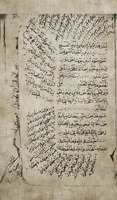
Malik 2551 folio 59 recto
Main: “I accept this rent for my client for the specified amount.” Fasting contract – first the renter says “I rent myself so that I can fast for thirty days for the price of such-and-such for which I have authority and on which I have deputyship, for the specified amount.” then the rentee says “I gave in rent to you for the specified action for the known amount.” The intention (niyyat) for rented prayer – I perform the prayer of noon, on behalf of so-and-so, which is obligatory, and [I perform it] on my behalf. May it bring closer to God, God is the greatest. The intention (niyyat) for fast that is rented – I will fast tomorrow, in the month of Ramadan on behalf of so-and-so, as is obligatory on him originally and [I perform it] on his behalf, may it bring him closer to God. Brotherhood contract (sigheh ukhuvvat)– I am your brother in Allah. I am pure with you in Allah. I shake your hands in front of God and make a covenant with God Margin: ?? Write – The intent (niyyat) is [made] at the home of the deceased and some say to make the intention for him. Caution dictates that the intent be made at the deceased’s home and at his grave as such, I will perform an umra’ and a tamatu’ pilgrimage proof of Islam (hujjat al-Islam) as deputy of so-and-so, as is obligatory, originally upon him and as deputy upon me, may it bring me closer to God. The proof of Islam means that it is clear that the pilgrimage is not a vow or expiation (kaffāra) but an obligatory pilgrimage and umra and… tamatu’ ??... that day he makes the tamatu’ pilgrimage… and from… Hiring Someone for Pilgrimage I have hired out myself to travel the blessed distance from here to Mecca and perform the pilgrimage of Islam, the Hajj of Tamatu’ by entering the state of ihram for the umra at the designated location of Miqat and carrying out all the rest of its rituals on behalf of so-and-so, for the [aforementioned] amount. And he says in response: I accept. From Shaykh Zayd… And in the jurisprudence of Reza (Pbuh) it is said that if you want to pack up goods at the store… recite the Throne verse and write it and place it in between the goods and this prayer… write with the Throne verse “and have placed a barrier before them and a barrier behind them and covered them up, so they fail to see [the truth].” (Qur’an 36:9) None of your making… upon that which God has protected “But if they turn away, then say, ‘Allah is sufficient for me. There is no god [worthy of worship] except Him. In Him I put my trust. And He is the Lord of the Mighty Throne.’” (Qur’an 9:129) If you do this those goods will be protected from any calamity by the permission of the exalted and majestic. -
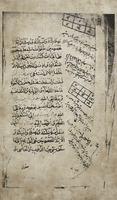
Malik 2551 folio 59 verso
Main: and His angels, His Prophets, His messengers and His infallible Imams, may God’s blessings be upon them all, that if I were among the people of paradise and intercession, and permission is granted me to enter, I will not enter unless you are with me. Then the one addressed will say, “I accept and hereby waive the rights of brotherhood with the exception of supplication, visitation, and intercession that bring closeness to God.” The contract for repentance, at first the intention is as such: “I repent from corruption, because it is obligatory, may it bring closeness to God,” and afterward he says three times: “I seek forgiveness from Allah the great, and repent unto him.” Then he says: “I bear witness before God, His angels, His messengers, His prophets and His infallible imams that I am repentant for all the sins and transgressions I have committed in the past, and Margin: In order for [ease of] birthing it should be tied to the thigh of the woman whereupon she will give birth. It should be untied after the birth, otherwise her intestines will come out. Where are you O, Shahyuna? For the birthing, it must be written on earthenware that has not been washed. Hold two in the hands and place two under the feet. 4 2 3 5 7 8 1 6 Prayer to recite in the ear of the traveler Those who impose upon you… will bring you back to the appointed place/time. If someone has a hard time delivering babies write these letters upon … white, throw it around the foot and she will deliver her load?, this is it W J H T D A … … … -
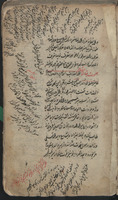
Malik 2551 folio 6 recto
Main: And Muhammad Nazar and Mirza Muhammad guaranteed that the sales contract conforms to the Shari’a, a legal (shar’i) guarantee, and going forward three sixth of the aforementioned specified storefront (dukkan) is given to the aforementioned customer, to take hold of in whatever manner he wishes, in accordance with “taking hold of a property from one’s properties is amongst his rights” in the month of so-and-so Facsimile of an ownership contract of objects: Praise be to Allah the Lord of the two worlds, and prayers and peace be upon the best of his creation, Muhammad and his entire family. The purpose of writing these introductory legal (shar’i) words is that because Muhammad Zaman Birinji [rice producer], the son of Mash Qasim, has passed away, his three sons named, Muhammad Qoli, Zahid, and Rasul and his wife who bears his sons, with the name of Shohreh Banu daughter of Muhammad Husayn who was biological kin, from the first son (az sar) the entirety of the 6 portions be given…which is bounded by the garden of Mir Muhammad extending to the house of Aqa Husayn Qomi and the house of Talib Bek and the house of Behzad all the way to the street. After Muhammad Qoli, Zahid, and Rasul died [the sons of Birinji) it is inherited by the already mentioned mother, Banu, and after Shohreh Banu also died [it is] inherited by the son of Qomi Margin: I certify to the deputyship here, [and] it is written by the lowly servant [of God] so-and-so who I confirmed as my absolute representative and deputy, the lowliest of servants, covered in benefits and favor, so-and-so son of so-and-so, living in such-and-such a place, [is] tasked to obtain the draft (barat) sum of 30 Tumans salary due to him from the proceeds of the endowment of his noble highness. The aforementioned draft is submitted to the [servant?] … so-and-so recorder of the imperial registers that is received and that [says] recover the aforementioned sum of 30 Tumans from the aforementioned. A correct, legal [Shar’i] deputyship, And this transpired in such-and-such month I hereby witness the representation of the poor slave [of God], so-and-so son of so-and-so, I witness the completion of this and I am the poor servant [of God] so-and-so son of so-and-so certify its contents for the esteemed aforementioned seller. May his noble and esteemed highness of elevated status, of exalted abode, with praiseworthy qualities and admirable character, (of protected residence?) extended be his elevated honor, always be, protected from the tricks of the age, in the protection and safety of the beneficent king [God]. Following the report of prayers that bear witness to your generous personality, I imagine that since at this time … If someone buys a book and writes on its margins, the two should be read together. And this book, named the Jami’ al-Abassi, the second, [that is] in the possession of a young man, the dear Riza Qoli, the oldest son of Karbala’i Vali Muhammad Qaramanlu living in the city of guidance, Ardabil, may Allah protect him from oppression and hardship, in the year Bars Yil 1137 (September 1724). -
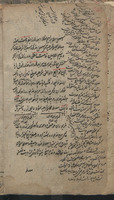
Malik 2551 folio 6 verso
Main: Ismā’īl son of Ibrāhīm only, and after he sold it through a correct and legal contract of sales [between] the aforementioned Ismā’īl and the individuals named: Sharīf son of Hāshim and Qāsim son of Amīn, the complete and entirety of the two full shares (dāng) from the total of six shares (dāng) of a house (sarācha) which is bound as described above along with the entirely of its legal subsidiaries and attachments for the price of nine thousand Tabrīzī Dīnārs according to the legal contract explaining and confirming its content (?), sold for the reported price of four thousand and five hundred Dīnārs. The entirety of the two shares of the aforementioned house was [given] to the aforementioned customers for the mentioned price and the legal contract of sales took place between them and it was completed. [thus] a legal, correct, agreement was made between the aforementioned seller and the customers. Mohammad Sharīf bought one share (dāng) Mohammad Qāsim bought one share (dāng) Any rights of claims or conversations that the aforementioned had in regards to the control of the entirety of the aforementioned sold property [is reconciled] in exchange with one thousand Tabrīzī Dīnārs whereby he [?] accepted the peace agreement and the contract of peace became enforced between them. The entirety of the price of one thousand Tabrīzī Dīnārs for the cost of Margin: Master of time Muhammad so-and-so And his dust became a martyr ?? from before??? Another letter May his excellency, the caesar-stationed, of praised qualities, of choice salutations, my patron (makhdūmī) Mirza of the Mirzas, Muhammad Mahdī—May the Almighty God keep him healthy—be continuously joined with health and accompanied by welfare. May you be the locus of advancement and prosperity, by His grace and inclination. After traversing the stages of longing and desiring, the protocols (rāy) of friendship requires that [I report that], blessing be from God and His grace, at the time of this penning, which is the 7th of such-and-such month, health is achieved and no aversion has occurred or happened upon [me] from tending to the attendants of my patron (makhdūmī). It is wished that the same is true from the other side [you] and that you have no ailments. It has been a long while since you have departed and yet, the majority of time the insignificant content [of our correspondence] has persisted and I do not appear ?? and content (shād) like all those who are loved (muhibbān). It is unclear what path the cause of your lack of attention [travels] yet it is hoped that your attention is facing the abundance (kisrat) of other smaller (juz’ī) engagements (mashāghil). At this time, the elevation sheltering so-and-so Beg of such-and-such tribe is setting course for your blessed (bā sawāb) direction. He arrived from tending to the affairs of the people at midnight [at which time] I desired (mayl) the delivery [of this letter] and so these two words were written in haste to be submitted to your sublime (sāmī) attendants. I will not interrupt your time any longer; may your days of vizierate be fortunate (khayr) and eternal (abadī). -
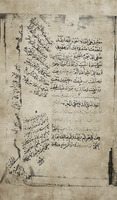
Malik 2551 folio 60 recto
Main: I vow not to return to it. I have made a covenant with God in this, a thousand covenants around my neck until the day of resurrection. The intention for the ‘funeral prayer’ – I recite the funeral prayer for the dead with the intention of fulfilling all that is obligatory of it as an act of drawing near to God. God is the greatest. The contract for sale (bay’) and purchase (shara) – I sold and reconciled. He will say “I accepted”. And also is [another example] “I gifted (wahabtu) and succeeded and reconciled” and in accepting it is said “I accept”. To [cure] corrupt thought, recite at the time of prayer; it is effective (mujarrab) – Oh the one, the lasting, beginning of all things and their end. If someone is heavily indebted and has no wealth to pay it and no one to give him [money], if he recites this poem correctly morning and night God almighty will see that his debt is paid. The blessing of this prayer will widen [increase] his sustenance and it is – Oh pure from all oppression, He did not approve of him and did not mix with him and his activities, oh pure one. In order to reach – greatness and wealth and repelling calamity and protecting Margin: This is the prayer for burial Oh God, Lord of this blessed and pure soil, Lord of the light that descended upon it, Lord of the corpse that dwells within it, and Lord of the angels entrusted to it, send blessings upon Muhammad and the family of Muhammad, and make this clay a source of security for me from all fear and misery, from every disease, such and such. End If someone is forgetful (kūrdil) [blindhearted] such that whatever he reads he forgets, he should recite seven times after the morning prayer for up to forty or forty one days. His servant Shmachael. This is the prayer: O Sustainer, nothing escapes your knowledge and nothing leaves… End -
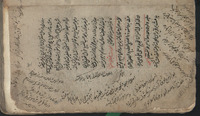
Malik 2551 folio 7 recto
Main: reconciliation was received by the aforementioned seller–Muhammad Sharīf–from the property of the aforementioned customers [buyers] as stated here, in cash and witnessed. And the guarantor–Muhammad Qāsim–reached a legal resolution through that which is prescribed in the illuminated Shari’a, which is “this is the exit sales in whole or in parts or benefits deserved by others”; it was a legal guarantee. According to this sales the entirety of the two shares (dāng) from the legal six shares (dāng) as in accordance with the above description belongs to the aforementioned customers and they can take ownership (tamallukāna) of it in whatever manner they desire; such is the control of an owner over his property. This transpired in the month of so-and-so from the year of the mouse (sichqān). Copy (surat) of the Oath Contract (qabāla al-qasam) Praise be to God the title of whose book is “in the name of Allah, the compassionate, the merciful” and the signet of whose speech is “verily Allah is the magnificent possessor of grace”, and greetings and peace be unto Muhammad ?? of the great secret and unto Alī, greater than great? and unto the children of these two, may they guide us to the straight path. And then, the reason for penning this legal preamble is that Margin: He is the excellency whose dignity is the reason for longing, the esteemed-valued one, of elevated worth and illuminated opinion, the so-and-so Turk?, may his grandeur extend and his lifetime lengthen. The Possessor of Time (sahib al-vaqt) sends prayers of longing to so-and-so lady (khanum) whose shadow even when far from sight, will not be far from memory. Sāmir?? I personally confirm the aforementioned sale with what is mentioned in it ... of excellent quality and due to the generosity of her highness, symbol of purity, [Queen] Sheba of stature, sunlight of the age, so-and-so lady (khanum) that ??? It is hoped that you are in the protected shelter of the divine enjoying the singularity of both worlds. After describing the euphoric desire to uncover the love-witnessing and purity-adorning sight, should you be inquiring? about the sad diseased state of your beloved, I must report that I achieved my health, which is the greatest fortune [from] ailment, and no loathing is present other than distance and separation [from you]. It is hoped that, through [your] charitable temper, the honor of your cherished presence (mulāqāt) will be possible. I hope that you announce... the duration of your .. the service... ... may the remainder of the days be to the liking of the grand-one???